Synopsis
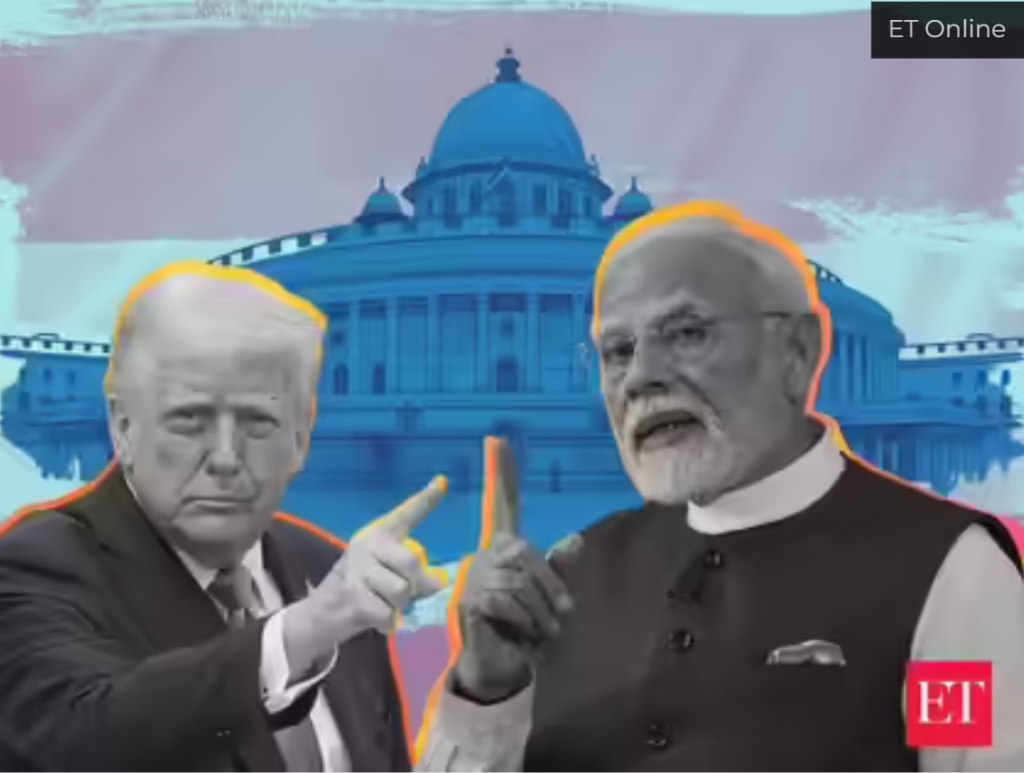
The India-US tariff deal has been widely criticised as a coerced compromise. While US tariffs on Indian goods have been cut from 50% to 18%, the reduction is largely a rollback of Trump-era economic pressure, not a generous offer. India’s government claims it has diversified oil supplies, but critics say being forced to abandon cheaper Russian crude for costlier US oil under threat of tariffs is submission, not diversification.
India-US tariff deal is a humiliating cave-in. This is not just a ‘trade deal’. India has been arm-twisted into giving up its sovereign right to buy oil from wherever it chooses, Russia in this case. Some analysts say realpolitik obliges India to submit until Trump’s term ends and the US hopefully gets a better president. Okay. But unlike the agreement with the EU, please do not call this the ‘mother of all deals’.
The fine print is still not available. Piyush Goyal calls it a landmark achievement. US tariffs on Indian goods have been cut from 50% to 18%. But they averaged something like 4% pre-Trump. So, the new reduction is not generosity. It’s a partial rollback of economic blackmail, accompanied by a warning that the blackmail can resume any time.
He has warned that he will raise tariffs again if he is ‘not satisfied’ with the outcome. This single clause destroys any illusion that the deal is a stable, negotiated agreement crafted to last. A trade agreement in which one side reserves the right to unilaterally walk away and impose penalties is not a deal. It’s economic intimidation dressed up as diplomacy.
Optimists like Brookings Institution’s Tanvi Madan have argued that India has often faced difficult trade-offs in foreign policy, and surrendered some positions to gain others. She says if realpolitik requires India to give up cheap Russian oil for a good strategic deal with the US, that can be a net foreign policy win. Alas, this presumes the deal is in some sense final and binding, and not the start of further demands.
Trump himself has said he will impose tariffs again if ‘unsatisfied’ with the outcomes. Months after signing a similar trade deal with South Korea, he reneged on it and slapped a 25% tariff, complaining that Seoul was not moving fast enough. Why expect he’ll treat India any better?
Rahul Gandhi is right in saying India has caved in to US pressure. GoI says it’s ‘diversifying oil supplies’ by abandoning cheap Russian crude for costlier US crude. Stuff and nonsense. Buying Russian oil at discounted prices was itself diversification to a source rarely tapped earlier. Being forced to abandon that option under threat of US tariffs is not diversification, but submission. Pankaj Srivastava of Rystad Energy, a Norwegian analyst firm, estimates that switching from Russian to US crude oil will cost India a stiff extra $12 a barrel.
Competitors such as Bangladesh, Pakistan and Vietnam now face a 20% tariff against India’s 18%. This merits maybe one small cheer. But the fact that some other countries now face slightly higher tariffs doesn’t make this deal a success. It merely shows how coercive and volatile the US trade regime has become.
India has agreed to eliminate, or reduce, import duties on a variety of US industrial and agricultural products. US officials boast of gaining major access to Indian agricultural markets, while Goyal says he has stood firm on protecting Indian farmers. He should have added, ‘For now.’ Let nobody think Trump is done with tariffs. He’ll use them repeatedly for future aims.
Ironically, the ruckus over trade in goods misses entirely the true future of India-US economic relations, which is in services (especially IT and AI). Services trade has been skyrocketing without any political or diplomatic manipulation or threats. India’s booming services are still a tad below goods exports, but are growing much faster. They represent India’s exports of the future, to the US and all others.
Amazon, Microsoft and Google have recently announced plans to invest over $67 bn in India in data centres and allied infrastructure, driven by pure market logic. The West, with its falling fertility, does not produce remotely enough STEM graduates for future AI development. India currently produces 3 mn STEM graduates annually, and plans to increase this to 18 mn by 2030.
Actual achievement will be far lower. Indian quality is spotty. But if even half of India’s STEM graduates are employable, that will meet the world’s needs and generate billions in service exports.
Ficci estimates that by 2030, India will have 2,400 GCCs of MNCs with 2.8 mn skilled workers, mostly in IT and AI, but also in R&D and engineering design. Earlier, such skill centres did not require much investment. But AI requires massive investment in data centres, which is now flooding in.
Trump has slashed H-1B visas for Indian IT workers, saying he wants IT done in the US and not in India. But his attempts during Trump 1.0 to keep out Indian IT workers failed, as the work simply moved out of the US to Indian GCCs. Will Trump penalise India for this too? Will he impose high tariffs to stop US companies from expanding data centres in India?
I suspect not, because US companies will tell him that India’s STEM workers are irreplaceable for developing AI to meet China’s challenge. That logic will be hard to override even by a loose cannon like Trump.
This article was originally published by The Economic Times on Feb 10, 2026.